In 2024, three best buddies and students of Symbiosis International School, Pune
Kiyan Kapur, along with Aria Khambatta and Nirvaan Thakur (both of whom are approachable, warm and well-liked psychology students)– decided to assist with matters of wellbeing among school students in their school.
He founded the Wellness Council, under the mentorship of Symbiosis teachers – a student-led movement that conducts fun social-emotional learning experiences through positive mental health activities. These classoom sessions become a safe place where children participate in real time, mood-boosting cognitive behavioural workshops, that build comaraderie, self-confidence, endorphins and resilience!


Team
Wellness Council
I was in my mother’s womb when my parents began building a health care centre. I have watched them nurture their dream project as an infant. That’s probably where I also started getting influenced.
Getting older, I witnessed their dedication to helping adults improve their lives through wellness activities. This was a dinner table conversation and their efforts featured in my bedtime stories too. I am lucky to experience this as an individual and as a family, early on.
In school, I am grateful for the teachers who were welcoming, non-judgmental and supportive. Their encouragement helped me evolve from a shy child, into a confident IG Captain (head boy) in the 10th standard. They have nothing but respect for the role they played in shaping my personality.
I’m all of 17 – with a great taste in music and an out-and-out people’s person. I love to be connected to people through their stories. I also happen to be Kiyan’s best friend since fifth grade.
I conducted activities for students of Grade 4C. My most memorable ones being goal-and-aim game where students had to throw a ball into a bin while blindfolded, freeflowing dance sessions to music videos playing on the smartboard. It had had everyone laughing and letting loose. A little laughter and a lot of empathy – for oneself and others – can go a long way.
Working with my best friend didn’t feel like a task. It helped us understand each other better and brought us closer. While conducting activities, we were building memories. Wellness Whisperer holds so much potential for all those who want to experience this.
At 17, I call myself a pet whisperer and an old soul with purpose. Don’t be surprised if you find me listening to a playlist of Schubert or pondering over Tolstoy quotes.
Teen age is a sensitive ‘era’ in our lives. It is filled with exam and peer tension. Along with Kiyan and Nirvaan, we created a wellness pocket with Ethics Council. It was a tribute to a school scape every student wished they had.
Since an early age, I work well in a system – students need a flow of routine and protocol. But there are cracks and it is important to address them. The project was directed to expose young students to the need for compassion, calm, and community. Making one student feel seen and supported was a personal win.
Together, they designed interactive sessions that would introduce the idea of wellness to kids and sow seeds for their journey towards good mental wellbeing. They conducted them simultaneously (in 3 sections) for Grade 4 students. The pilot was successful and well-received… and these activities have been expanded to help Grade 1-5 students. Take a look!
Overnight, the trio became the cool senior kids to the juniors and they realised that in giving they were receiving awkward hugs, high fives and shy greetings every single day.
1. Wellness Bingo
Focus Area:
- This activity cultivates actionable, Micro-moments of Kindness that can ease a school day.
- Simple gestures during the activity fosters positive social interactions and promotes Connection and Positive Feelings among participants
- Enacting a kind deed encourages students to be aware of the people around them and thus, enhances Present Moment Awareness
TAKE AWAY: Thanks to these subtle moments of wellness, reflection and kindness, the Students were loving the activity. And as importantly, they were at the same time, unknowingly becoming more present and mentally healthier!

One kind deed doesn’t take more than a few seconds or a few sentences. Wellness Bingo encouraged participants to take a few seconds to carry out a flex kindness: Give someone a high-five, compliment a classmate, pick up the trash, hold the door for the person after you, draw a happy face for a friend, etc. Wellness bingo made it possible to spread joy within just a few moments.
2. Pass the parcel

We’ve all played passing the parcel as kids. This version had a twist: Whoever held the object when the music stopped had to compliment the person sitting on his/her left and right. Happy hormones galore, let the music stop, the feel-good emotion continues. Only gratitude, no punishments.
Focus Area:
- A direct focus on expressing positive regard for peers encourages Practicing Gratitude and Appreciation
- When students acknowledge good in their classmates, it builds Positive Peer Relationships
- The absence of punishment creates a Supportive and Uplifting Atmosphere
TAKE AWAY: Participants get a real-time experience of practising gratitude and observing their energy change instantly
3. Balance relay
Focus Area:
- Pairing a physical challenge with an introspective question integrates Mindfulness and Physical Coordination
- By sharing simple aspects of one’s life, a student is encouraged to Self Reflect and Share
- The balancing task demands concentration and being present, thus Promoting Focus and Presence
TAKE AWAY: Stepping out of your comfort zone and trying a mental-motor coordination exercise can bring agility and alertness to the body and mind.

Balancing a book on your head is ‘focus in motion’. Each participant was made to walk their way to the wellness jar, while balancing the book on their heads. Once they reached the jar, the book was put down and they had to pick a chit and answer a question about themselves. From favourite fruits to the last time they helped out someone at home or school, the activity combined motor skills with balance in a fun way.
4. The Thrower and the Coach
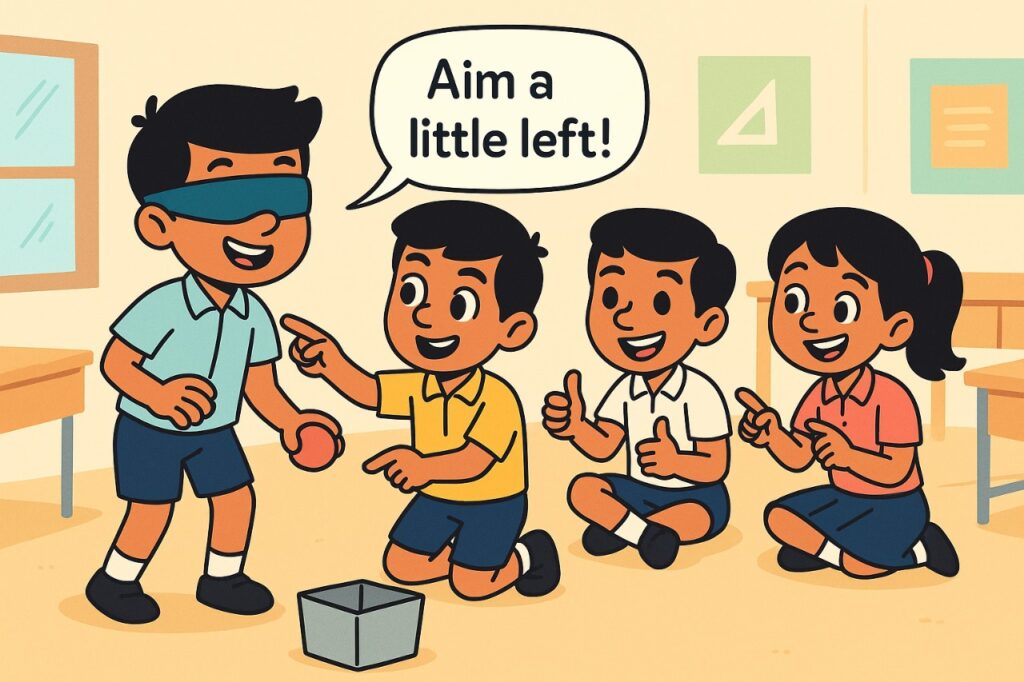
This was a two-player game in which one blindfolded thrower would be spun and then be positioned to take instructions from the partner, who in turn would coach him/her to aim a ball into a bin. It required the players to relay precise instructions and act upon them with intuition and confidence.
Focus Area:
- The reliance on clear verbal instruction and the thrower's trust in their partner develops Trust and Communication Skills
- Effective communication and listening enhances Active Listening and Precise Instruction
- Relying on the partner’s instructions builds Intuition and Confidence
TAKE AWAY: Team spirit is hard work, but it is eased with patience, involvement and thinking for your partner.
5. Emotional charades
Focus Area:
- The game helps students recognise and understand different emotions and leaves Emotional Literacy
- The requirement to understand another’s perspective encourages Empathy and Perspective-Taking
- Application of body language and facial expression to communicate feelings Fosters Non-Verbal Communication Skills
TAKE AWAY: Accepting and expressing emotions is a great communication asset

One team enacts out an emotion for the opponent’s team to guess. The winning point belongs to both the teams!
6. Dance like nobody's watching

Dance sheds inhibitions and when you dance without care, you encourage others around you to also join in and let loose. This was a most heartening activity where we asked students to face a video screen and enact the hook steps of popular songs such as Gangnam style and Waka Waka. With a few beats, they forgot they were in a class full of their peers, and didn’t care who was watching.
Focus Area:
- Movement in public eases awkward self-consciousness. This helps reduce Inhibitions and Promotes Self-Expression
- Mood-boosting effects of music and movement Foster Joy and Positive Energy.
- Dancing together breaks social barriers and Creates a Sense of Shared Fun and Community
TAKE AWAY: A natural dopamine hit can set a day right. Dancing, alone or in a group, is therapeutic and rejuvenating
IB SCHOOL WELLNESS SYLLABUS UNDER PRIMARY YEARS PROGRAMME
Most IB schools offer a Wellness Syllabus under Primary Years Programme designed for students aged 3 to 12. The Wellness Council referred to the syllabus introduced by Symbiosis School, Pune.
How to organise ideas/ thoughts
Where students explore their interests, abilities and set goals
Where students inquire into how we can develop and promote international mindedness
Where they explore Wait & cool off, Walk away, Talk about it, Reflect, Apologise and Ignore techniques
Where they work on the aspect of conflict resolution through I-messages. Template example: I feel…………….when you……………because………..”